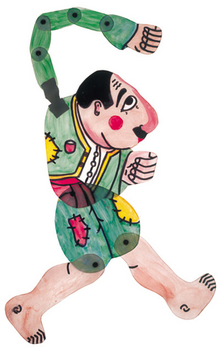
Since we are surprisingly popular in Greece (the editor of this blog Tilly Gokbudak, who is me, is a Turkish-American), we thought we's post the first entry of 2013 with an image of the Greek shadow puppet Karagiozis who really sets a bad example for children by walking barefoot (we are just kidding....we like being populr in Greece).
Karagiozis has a Turkish counterpart in Karagoz, a bearded anti-intellectual, who frequently bouts with his frenemy, the benevolent Hacivat.
One of our hopes for this year is to post a weekly round-up of weather temps around the globe on Wednesdays. We will probably annoy folks in both Greece and Turkey by posting the temps in Fahreinhiet, but perhaps one day, we will use Celsius as well.
Here we go:
Athens, Greece 51 (partly cloudy)
Boulder, Colorado* 10 (snow)
Charlottesville, Virginia* 48 (cloudy)
Istanbul, Turkey 45 (rain/yagmur)
Lawrence, Kansas 30 (cloudy)
Paris, France 38 (cloudy)
Vancouver, British Columbia, Canada 28 (partly cloudy)
*- These are American cities, all of which are also college towns.
Showing posts with label Karagiozis. Show all posts
Saturday, January 12, 2013
This Blog Will Go On.....
Labels:
Boulder,
Charlottesville,
Colorado,
Greece,
Hacivat,
Karagiozis,
Karagoz,
Turkey,
Virginia,
weather
Sunday, January 1, 2012
Happy New Year from Karagoz and Hacivat
For complicated reasons that we went into greater deal with on our other blog "The Daily Vampire," Turkey and France are not getting along well these days. For the entry on our sister blog, we sent New Year's greetings from the beloved French comic book character Asterix the Gaul. Here, we shall go with a much older entity in the Turkish shadow puppet figures of Karagoz and Hacivat, whom we believe may actually be in the public domain as Turkey has traditionally had more lax copyright laws than Europe and America.
Karagoz, the one with the beard, and Hacivat, the one with the mustache, are the lead characters in Turkish shadow puppet theatre. There is considerable dispute as to when the plays were first performed. According to Wikipedia, it was long believed that Karagoz and Hacivat first appeared during the reign of Sultan Selim (1512-1520), but there is historical evidence to suggest they go back even further in time than the 16th century.
Karagoz represents the semi-literate village dwellers while Hacivat symbolizes educated intellectuals. The plays remain very timely to this day because children can be entertained by them while adults can observe how these two characters represent the deep divides in Turkey, which exist to this very day. Conversely, Karagoz and Hacivat are the best of friends, yet they also can't stand each other.
Secondary characters in the plays, which usually run about ten minutes each, include the Drunkard, Zeybek and the old woman. The plays always conclude with Karagoz and Hacivat having a major argument. There is a similar Greek shadow puppet character named Karagiozis. In both Turkey and Greece, there has always been a concern that each passing generation will be less interested in traditional shadow puppet theatre than the previous one. And, tourists have been known to take a greater interest in shadow puppet theatre than the natives.
In Turkey, Karagoz and Hacivat have long been associated with Bursa, Turkey's fourth largest city and former Ottoman capital, before Sultan Mehmet the Conqueror came to the Bosporus shores of Constantinople/Istanbul in 1453.
Happy New Year to everyone, and we hope you keep reading this blog in 2012.
SIDEBAR: The answer to our Road Trip Quiz from last week was "C" and the answer to the Rabbit Ears Quiz question about "The Brady Bunch" was "A."
Thursday, June 30, 2011
Things We Learned on NPR Last Week-Problems with the Other Neighbor

Greece is making international headlines due to its financial crisis which has caused riots on the streets. Though the events are not quite as violent or dramatic, as the fall-out from the Arab Spring in Syria, Yemen and Libya, the government in Athens is undoubtedly overwhelmed at the moment.
For centuries upon centuries, Greece's main rival has always been Turkey, my late father's country. I once wore a t-shirt from the Turkish resort of Kusadasi while visiting the Greek island of Rhodes as a teenager in 1985, and yes, the locals noticed!
But, at the moment, Greece seems to having even more of a rift with Macedonia, a former Yugoslav republic that is now its own independent, small nation.
As the always brilliant NPR show "The World" (which we should perhaps listen to more often) reported last week, Macedonia unveiled a towering 92-foot statue of Alexander the Great in the capital city of Skopje. The problem is that the Greeks consider Alexander the Great, who was ironically an inspiration to Sultan Suleyman the Magnificient, as their national hero.
The radio series also said in its report that there are already plenty of tensions between Skopje and Athens as Greece has repeatedly tried to block Macedonia's entrance into the European Union.
All of this brings us to the reason why we chose Karagiozis, a Greek version of the Turkish shadow puppet Karagoz, as our image to go with this entry.
As it turns out, both Turkey and Greece have many cultural overlaps. And, the Greek shadow-puppeteer Sotris Haridimos currently has a traveling Karagiozis roadshow in Greece, which an American travel writer saw in Athens and reported on for his travel blog.
Like Karagoz, his Greek counterpart represents the plight of the average person. And, given Greece's domestic turoil, and Turkey's struggles with an overwhelming influx of refugees from Syria, it seems that both countries are a bit overwhelmed these days. And, very few tourists visiting the resort town of Bodrum, Turkey, and the Greek island of Kos, a mere three miles off Bodrum's coast, are concerned about any of this.
SIDEBAR: It is official. The Wimbledon women's final will be between Petra Kvitova of the Czech Republic and Russian superstar Maria Sharapova. If we had John McEnroe's email, we'd ask him who he likes on this one. But, then again, I may say something to tick him off, and that would be like an eruption of Mount Pinatubo.
Labels:
Greece,
John McEnroe,
Karagiozis,
Karagoz,
Macedonia,
Maria Sharapova,
Mount Pinatubo,
NPR,
Petra Kvitova,
Syria,
Turkey,
women's tennis,
Yemen
Subscribe to:
Comments (Atom)